
Hold a chord. Get a sequence.
The arpeggiator in the SynthB synth turns a held chord into a pattern. It goes beyond up and down: a sixteen-step lane transposes and accents every step, so one chord can become a whole riff.
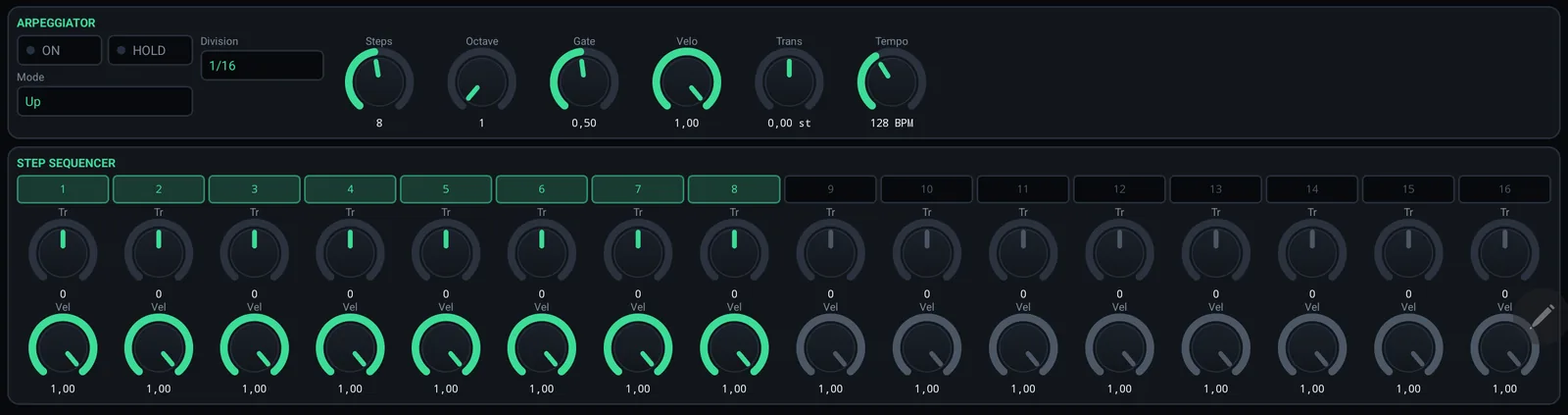
Nine modes
Up, Down, Up-Down and Down-Up. Two more variants of those don't repeat the top and bottom notes. Ordered plays the notes as you pressed them, Random shuffles them, and Chord plays the whole chord on each step, for stabs and gated chords.
The controls
| ON / HOLD | Switch it on. HOLD keeps the chord going after you lift your fingers. |
| Division | The note length of each step, from slow to fast rolls. |
| Steps | Pattern length, up to 16. |
| Octave | How many octaves the pattern climbs through. |
| Gate | Note length: short plucks or legato lines. |
| Velo | How much the velocity lane counts. |
| Trans | Transposes the whole pattern. |
The 16-step lane
Each of the sixteen steps has an on/off switch, a transpose and a velocity. Switch steps off for rhythm, transpose a few up an octave or a fifth for movement, and accent the downbeats. Steps past the pattern length are dimmed but keep their settings, so you can shorten and lengthen the pattern without losing work.
Where it fits
- Trance and synthwave plucks: a SynthB pluck, Up-Down at 1/16, gate around half.
- Bass sequences: Ordered mode, one octave, accents on the lane.
- Ambient beds: Random mode, slow division, a long reverb on a send.
Hold a chord on the on-screen keyboard, or play one on a USB MIDI keyboard. Record the result with the live looper, then play something else over it.