
Make sounds move: LFOs, envelopes and a mod matrix
A static sound is a demo. A sound that breathes, wobbles and responds to how you play is an instrument. Modulation is how the SynthB synth gets there.
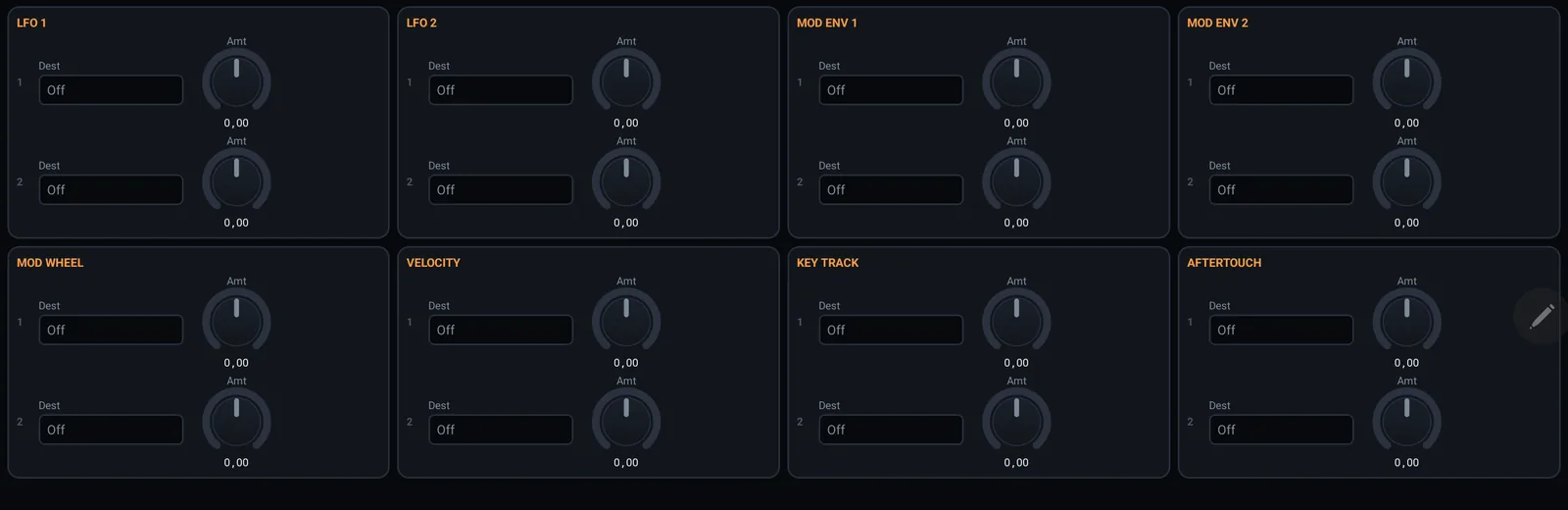
Sources
Each of the synth's two layers has its own modulators:
- Two LFOs with seven shapes, including sample-and-hold and a smoothed random. They can run free or synced to the tempo, per note or shared by all voices, with depth and start phase.
- Two mod envelopes with analog-style exponential segments: a fast start and a long tail.
- Mod wheel, velocity, key track and aftertouch from the keyboard or a MIDI controller.

The matrix: 8 sources × 46 destinations
Every source gets two slots, each with a destination and an amount, positive or negative. There are 46 destinations: volume, pitch, pulse width, phase and pan per layer, filter cutoff, resonance and drive, the LFOs' depth and rate, the A/B mix, and master and effect parameters such as delay feedback, chorus depth and reverb size.
Destinations are named by layer (A, B or AB), so layer A's LFO can open layer B's filter. Empty slots cost no CPU at all: sources that are not routed are not computed.
Classic routings
| Source | Destination | Result |
|---|---|---|
| LFO 1 (synced 1/8) | Cutoff | Wobble bass |
| Mod env 1 | Pitch | Zap and laser attacks |
| Velocity | Cutoff | Play harder, sound brighter |
| Mod wheel | LFO 1 gain | Vibrato or wobble when you push the wheel |
| LFO 2 (random) | Pan | Notes that drift across the stereo field |
Want to move something across a whole song instead of a single note? Use an automation clip.