
A four-operator FM synth for glassy keys and hard basses
FM synthesis made the electric pianos, bells and slap basses of the 1980s, and it is still the quickest way to a bright, metallic or punchy tone. SynthB's FM synth keeps it playable: four operators, eight algorithms and starting sounds you can bend.
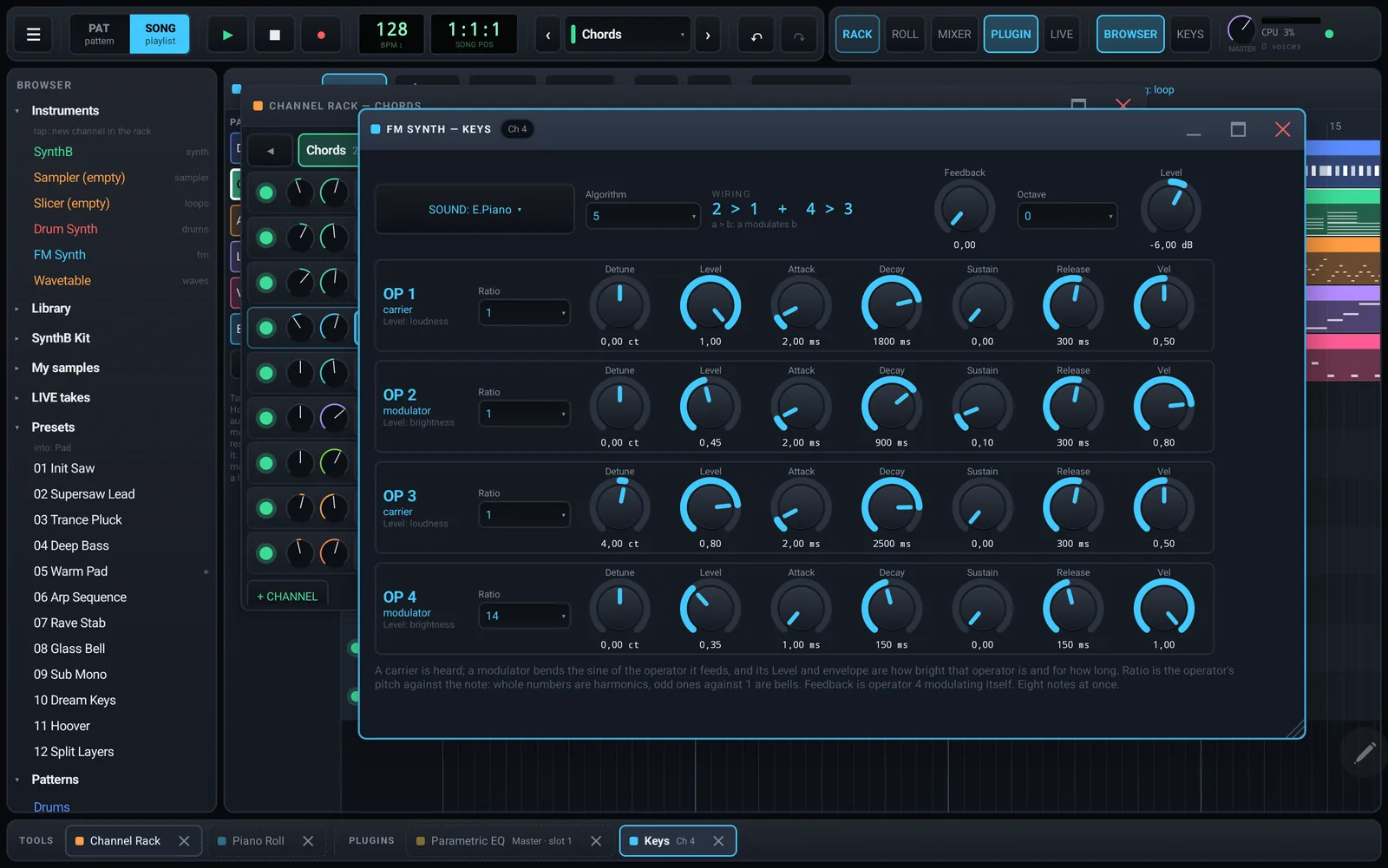
How it works, briefly
An operator is a sine-wave oscillator with its own envelope. In FM, some operators (modulators) bend the pitch of others (carriers) so fast that the result is a new timbre rather than a vibrato. The algorithm decides which operators modulate which. The ratio between them decides whether the result sounds harmonic, like keys and brass, or clangy, like bells and metal.
The controls
| Algorithm | Eight ways to connect the four operators, from stacked chains to four carriers side by side. |
| Feedback | An operator modulating itself, from a soft edge to buzz and noise. |
| Ratio | Each operator's frequency relative to the note, 0 to 16. |
| Detune | ±50 cents per operator, for beating and width. |
| Level | How loud a carrier is, or how hard a modulator modulates. |
| ADSR | An envelope per operator. A fast-decaying modulator is the "tine" of an electric piano. |
| Vel | Velocity per operator: play harder and the sound gets brighter, as on a real piano. |
| Octave / Level | Range and output for the whole instrument. |
The synth plays eight notes at once, enough for full chords with a long release.
Start from a sound
FM is famously hard to program from scratch, so SynthB includes starting points: E.Piano, Bell, Bass, Organ and more. Load one and change a ratio or an envelope. You learn FM faster by hearing what one knob does than by reading about it.
Where FM shines in a mix
- Lo-fi and neo-soul keys: E.Piano into chorus and a little bitcrusher.
- Bell melodies over pads: they cut through without taking up much space.
- Basses with a fast modulator envelope for a percussive attack.